
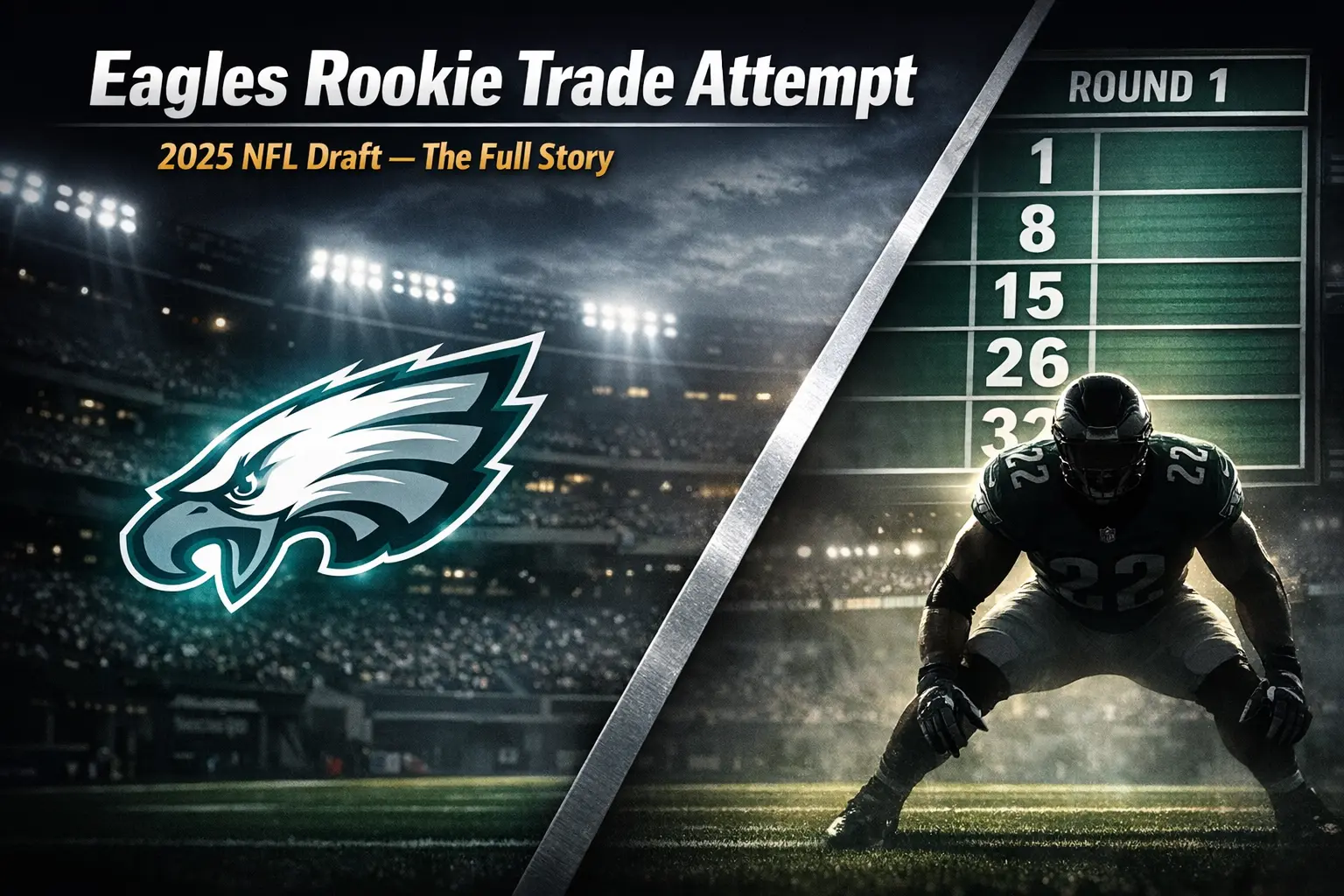
The Eagles’ first-round selection at the 2025 NFL Draft which I watched from my couch made me think that the team had planned to select Campbell before their pick at No. 31. The eagles rookie trade attempt to get into the top 20 tells you more about how Philadelphia actually builds a roster than any single pick ever could.
Most coverage stopped at “they tried, it didn’t work, they got him anyway.” The actual story shows what Howie Roseman intended to pay and his reasons for stopping his payment which determines the Eagles’ future operations.
What the Eagles Rookie Trade Attempt Actually Was
The Philadelphia Eagles entered the 2025 NFL Draft with a specific defensive target: Jihaad Campbell, the Alabama linebacker who had drawn comparisons to the kind of sideline-to-sideline coverage linebacker that modern NFL offenses force teams to find. The Eagles explored moving into the top 20—reports placed the target around pick No. 18—to guarantee their selection.
When the compensation demands from teams holding those picks came back, the price exceeded what the front office considered fair value. Future second or third round picks were likely on the table as required assets. Roseman pulled back.
What happened next validated the decision almost immediately. Unexpected selections ahead of the Eagles caused Campbell to slide. Philadelphia needed only a minor one-spot move—from No. 32 to No. 31—to secure the same player they had been willing to pay significantly more for just hours earlier.
The eagles rookie trade attempt wasn’t a failed mission. It was a patient one.
Why Campbell Was Worth the Pursuit
Modern NFL defenses live and die by linebacker versatility. The days of a pure run-stopper anchoring the middle are largely gone. Offenses spread formations, motion receivers pre-snap, and force linebackers to diagnose and react in fractions of a second. A linebacker who can’t cover space or match up in pass situations becomes a liability on roughly 60% of defensive snaps.
Campbell addressed that directly. His college profile showed strong range from sideline to sideline, reliable coverage instincts, and an ability to process information quickly—qualities that translate to defensive improvement beyond just his own performance. When a linebacker raises the floor of an entire unit, front offices classify that as a building block rather than a rotational piece.
That evaluation justified aggressive pursuit. It also explains why the Eagles were willing to explore a significant trade in the first place, even before the draft board created a more favorable outcome.
What the Decision Reveals About Howie Roseman’s Philosophy
The eagles rookie trade attempt fits a specific pattern if you’ve tracked Roseman’s draft history carefully. He pursues bold moves consistently. He almost never commits beyond a price he considers rational.
That distinction matters more than it sounds. Many front offices make emotional draft decisions—overpaying because a target feels irreplaceable in the moment, then spending the next two years compensating for the lost picks. Roseman has largely avoided that pattern by treating draft capital as a long-term resource rather than something to spend aggressively in a single cycle.
The three-step framework that defines his approach plays out clearly here: identify the player with elite traits, explore every available trade path to reach him, then walk away when the market price exceeds internal valuation. Patience isn’t passivity in this system. It’s a competitive tool.
Supporting Moves That Completed the Picture
The Campbell selection didn’t happen in isolation. The Eagles made two additional moves around the same period that reinforced the same disciplined logic.
A trade sending defensive tackle Thomas Booker to the Raiders returned cornerback Jakorian Bennett. The transaction converted redundant defensive line depth into secondary reinforcement—a positional need that the draft alone hadn’t fully addressed. It didn’t generate significant media attention, but it reflects exactly how thoughtful roster construction works: identifying inefficiencies and correcting them through available market opportunities.
The addition of quarterback Sam Howell addressed a different kind of vulnerability. With backup Tanner McKee managing a minor injury situation, the Eagles moved early rather than waiting for the problem to become urgent. Quarterback depth across a 17-game season isn’t glamorous, but losing stability behind a starter like Jalen Hurts to an avoidable situation would have been far more costly than the asset required to prevent it.
The 2026 Draft Capital Consequence
One element that separates this story from a simple draft recap is what the Eagles preserved by declining the expensive trade.
Philadelphia enters the 2026 draft cycle with projected multiple selections, including possible compensatory picks. That flexibility represents real options: the ability to trade up if a target slides or a team becomes motivated to move, the ability to add depth across multiple positions, or the ability to package picks for a different kind of roster upgrade entirely.
Teams that overpay in one draft cycle frequently find themselves spectators in the next one, limited to whatever picks remain after an expensive commitment. The Eagles avoided that constraint by accepting the short-term uncertainty of not controlling their pick position—and were rewarded when the board moved in their direction anyway.
Draft capital compounds in value when it’s protected consistently. One disciplined decision in 2025 quietly expands what’s possible in 2026.
Separating Confirmed Facts From Noise
The period surrounding the draft generated speculation about players who were never actually moved. Rumors involving A.J. Brown circulated with enough frequency that some coverage treated them as credible. No confirmed transaction occurred.
Early 2026 discussions about Tanner McKee’s future with the team remain speculative absent official confirmation. Separating verified transactions from league-wide discussion is particularly important in Eagles coverage because the franchise’s profile generates significant rumor volume regardless of actual front office activity.
The confirmed sequence remains: Campbell was targeted aggressively, the expensive trade was declined on valuation grounds, and he was selected at No. 31 through a minor move. Everything else requires verification before being treated as fact.
Realistic Expectations for What This Means
Campbell’s selection improves the Eagles’ linebacker depth and coverage capability. It does not transform the defense overnight. Rookies, regardless of draft position or pre-draft profile, face an adjustment period in the NFL that college production doesn’t fully prepare them for.
The eagles rookie trade attempt story ultimately matters most as a process signal rather than a result guarantee. Philadelphia identified a need, pursued a solution through multiple available paths, maintained financial discipline when the price exceeded value, and secured their target anyway. That process doesn’t guarantee Campbell becomes the player they projected. It does suggest the front office is operating with a coherent, consistent framework rather than reacting to individual draft moments without broader strategic context.
What happens in 2026—both with Campbell’s development and with the draft capital the Eagles preserved—will determine whether this disciplined approach produced the outcome it was designed to create.
Frequently Asked Questions
What exactly was the eagles rookie trade attempt?
During the 2025 NFL Draft, the Eagles explored trading into the top 20—reportedly around pick No. 18—to select Alabama linebacker Jihaad Campbell. When teams demanded compensation the Eagles considered too expensive, they declined and ultimately selected Campbell at No. 31 through a minor one-spot trade.
Why did the Eagles stop pursuing the top 20 trade?
The reported asking price required significant future draft assets, likely future second or third round picks. Roseman’s documented approach involves walking away when market price exceeds internal valuation, which is what happened here. The Eagles trusted their draft board over the impulse to guarantee their position.
Did declining the trade hurt the Eagles?
No—it produced a better outcome than overpaying would have. Campbell slid to No. 31 due to unexpected selections ahead of Philadelphia, meaning the Eagles secured their target without the expensive compensation the top 20 trade would have required.
What other moves did the Eagles make around the same time?
Two complementary moves completed the picture: trading Thomas Booker for cornerback Jakorian Bennett, which converted defensive line depth into secondary help, and acquiring quarterback Sam Howell to reinforce depth behind Jalen Hurts during a minor Tanner McKee injury situation.
How does this affect the Eagles’ 2026 draft?
By avoiding an expensive trade, Philadelphia preserved multiple projected 2026 selections including possible compensatory picks. That flexibility supports future trade activity, depth additions, or roster upgrades that wouldn’t have been available had the costly trade been completed.
Is Campbell guaranteed to succeed with the Eagles?
No. Draft position and pre-draft profile don’t guarantee NFL performance. The trade story matters as a process signal—evidence that the front office operates with consistent strategic logic—rather than a performance guarantee for any individual player.
Were the A.J. Brown trade rumors connected to this situation?
No confirmed connection exists. Speculation about Brown circulated during this period, but no transaction occurred. Separating verified moves from rumor volume is particularly important with a high-profile franchise like Philadelphia, where speculation routinely outpaces actual front office activity.
Following the Eagles Decision Closely
The assessment of Roseman’s draft strategies should take into account his complete career because selecting players from each draft should be evaluated individually. The pattern across years reveals more about front office philosophy than any single pick or trade decision.
The Eagles need to monitor Campbell’s playing time during the upcoming 2026 season. The coaching staff’s decisions about Campbell’s starting position and their use of him during coverage practice will reveal whether the Eagles’ pre-draft assessment matched their actual practice and film evaluation results.
The 2026 draft capital situation requires continuous monitoring until it reaches its final status. The picks preserved from this disciplined decision represent real options that will shape what Philadelphia can do in the next cycle. The Eagles rookie trade attempt created a secondary effect which might turn out to be as important as Campbell’s actual selection.
The evaluation of this story needs to be conducted without outcome bias. The Eagles made the disciplined choice, were rewarded when the board cooperated, and positioned themselves well for what comes next. The situation requires understanding because it will continue to exist until Campbell completes his first professional season.