
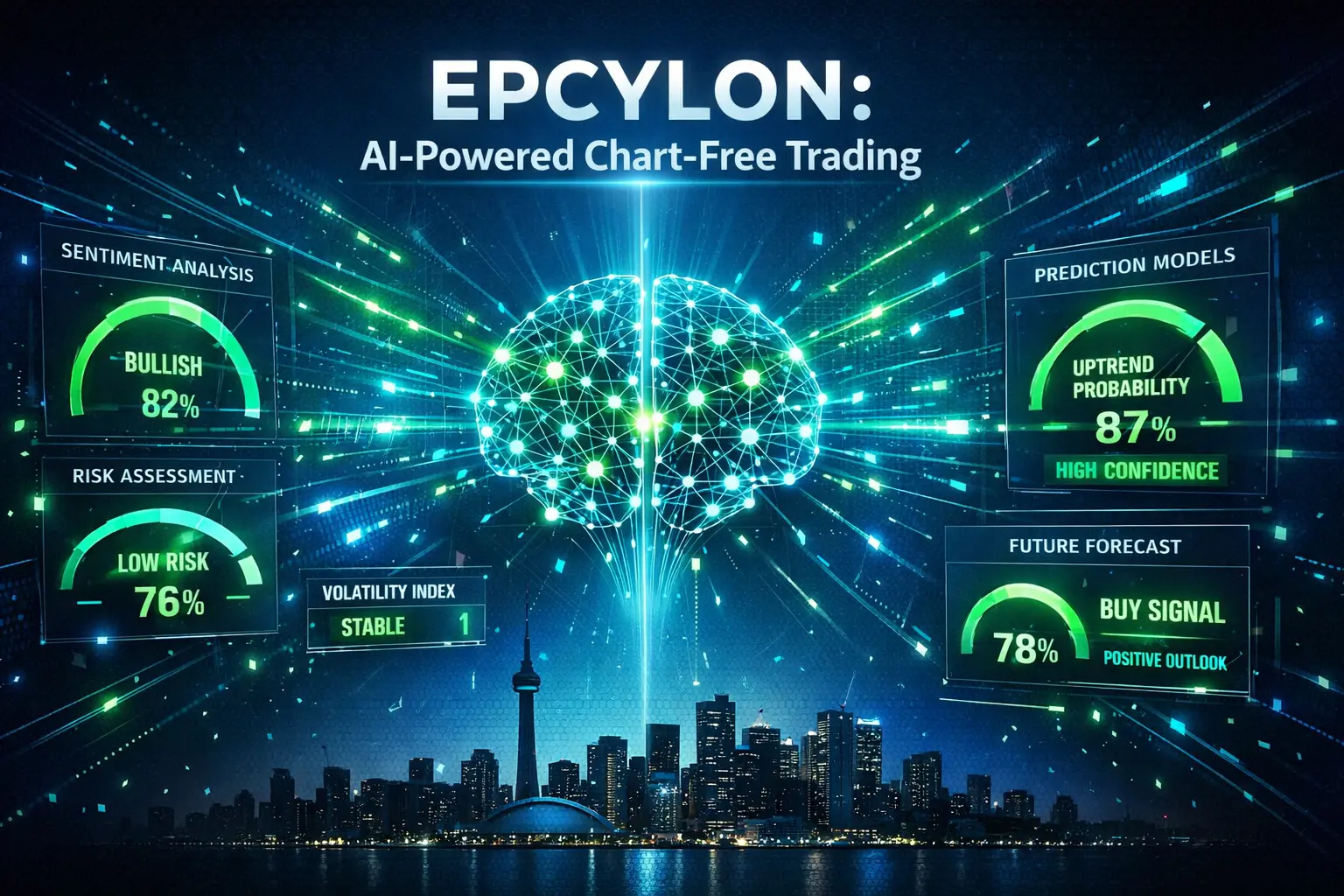
Remember when everyone said you needed years of experience to trade stocks profitably? One Toronto-based company challenged that assumption completely. Their solution didn’t involve complicated charts or hundreds of indicators—just artificial intelligence predicting where prices would move next.
That company was Epcylon, and their story reveals both the promise and challenges of using AI to democratize trading.
What Is Epcylon?
Epcylon Technologies was a financial technology firm that created smart trading software for the worldwide stock markets. Established roughly in 2009 and listed on the stock market with the ticker symbol PRFC, the company developed its own platforms that enfolded artificial intelligence in the process of simplifying securities trading.
The major product of the company, Stealth Trader, was an entire new way of trading compared to tools used by the industry before. Rather than training the users to read candlestick patterns or moving averages, it relied on the concept of machine learning to anticipate the short-term price swings by the behavior of the market participants.
The system was constantly analyzing electronic order books to produce the most likely trading signals which were based on market sentiment, trader commitment, and buying pressure. No user had to be familiar with the Fibonacci retracements or RSI oscillators. The AI was responsible for all the heavy lifting.
The hallmark of this particular method was its focus on the non-chart trading. The majority of retail traders will take months to learn technical analysis and even then there would be no guarantee of it to be right. By turning down the barrier, Epcylon was able to deliver complex market analysis in simple, actionable insights that anybody could understand.
How Epcylon’s Technology Actually Worked
Stealth Trader’s key innovation was the sentiment analysis engine. The system rather than depending on historical price patterns, it rater monitored how the market was participating during the instant.
Just like the reading of poker tells, only for the thousands of traders at the same time. The AI followed the order flow, levels of commitment, and the behavioral patterns in order to predict the security prices within certain intraday timeframes.
The technology supported multiple asset classes:
Equities – Individual stocks across major exchanges
Options – Derivatives contracts with varying strike prices
Futures – Commodity and index futures contracts
ETFs – Exchange-traded funds tracking indices or sectors
Currencies – Foreign exchange pairs in the forex market
Epcylon integrated with professional trading platforms like Sterling Trader and even became an approved Bloomberg Power App, distributing through Bloomberg’s network of over 325,000 terminals worldwide. That Bloomberg partnership was significant—it put their technology in front of institutional traders, not just retail customers.
Their proprietary algorithms had reportedly been in development for over a decade, incorporating machine learning techniques that improved as they processed more market data.
The Business Strategy and Partnerships
In the years spanning from 2015 to 2019, Epcylon took a number of steps to broaden their market and corroborate their technology.
A trading pit was installed in the center of the office they took at 34 King Street East in Toronto’s financial district—a tangible sign of their allegiance to the trading community.
Another significant deal was with Global Prime Trader (GPT), who gave them trading capital of $10 million. By this arrangement, Epcylon was sharing 80% of net trading profits while GPT had 20% for the first three months. GPT was running five market centers with more than 1,000 traders globally and was trading around one billion shares per month, which provided Epcylon with real-world validation at a big scale.
The firm also got distribution deals for Asia that included China, Hong Kong, Taiwan, Singapore, and Japan. The move was to aim at the increasing need for sophisticated mobile trading tools in the region of Asian financial markets that are getting more and more deregulated.
Doug McKay, the Director of Trading & Education at Epcylon, has always been stressing their value proposition: mastering traditional technical analysis could take “months, if not years” with no guarantee of profitability, while Stealth Trader let that learning curve become very short.
Why Chart-Free Trading Mattered
Traditional trading education is a long, drawn-out process and an intimidating ordeal. It comprises such matters as trading with Japanese candlesticks, determining the support and resistance levels, trend channels, conducting volume analysis, using momentum indicators and other dozens of other concepts before you can even think about making a trade.
Even those traders who have gained command over these tools lose money, however. The emotional discipline for executing a trading plan consistently is often more difficult than the technical knowledge itself and by that time most traders have already developed the wrong attitude.
Epcylon’s philosophy was entirely opposite. They considered market sentiment— the combined psychology and commitment of active traders— as more predictive than strictly historical price patterns.
Just by looking at order book behavior in real time, their AI spotted high-probability setups without requiring users to be technical analysis experts. The goal was democratization: making sophisticated trading intelligence accessible to beginners and experienced traders alike.
Jack Bensimon, Epcylon’s CEO, called Stealth Trader “a leading indicator of where prices are headed based on market sentiment.” The distinction is highlighted as most indicators are lagging showing what has already occurred rather than predicting what is coming next.
The Transformation to QuantGate Systems
In November 2019, Epcylon made a bold move by rebranding itself to QuantGate Systems Inc. This was not only a name change but also a strategic move towards using AI and machine learning for different purposes rather than only for trading intelligence.
The company was already taking steps toward a new management team and updating financial reports on the OTC Markets platform. They were highlighting this transition as a method of gaining both institutional and retail product recognition globally while at the same time increasing their AI capability.
Post rebranding, the company’s operations were not as transparent as before regarding public information. As with a lot of fintech startups, the transitional phase was accompanied by the restructuring and refocusing of the business model, but still, there are no figures about current operations made public.
Common Questions About Epcylon
What happened to Epcylon Technologies?
Epcylon rebranded as QuantGate Systems Inc. in late 2019 to better reflect its expanded focus on artificial intelligence and machine learning solutions. The company continued trading under ticker symbol PRFC but shifted from purely trading-focused products toward broader fintech applications.
Was Stealth Trader actually profitable?
The company demonstrated their Colony Auto-Trader algorithm showed positive expectancy through backtesting across various securities and timeframes. However, like all trading systems, real-world results depended heavily on market conditions, proper implementation, and disciplined risk management practices.
How did the AI predict price movements?
Instead of scrutinizing past pattern charts, Epcylon’s algorithms dealt with current electronic order book data to gauge the mood of the market players, their commitment, and the patterns of their trading behavior. This method regarded the price movement as a result of overall trader mindset rather than as a result of technical formations.
Who were Epcylon’s main competitors?
The chart-free trading concept was relatively unique. Traditional competitors included technical analysis platforms like TradingView, MetaTrader, and Thinkorswim, though these relied on conventional charting approaches. Other AI-driven trading tools existed, but few positioned themselves as completely chart-free.
Is Epcylon still operating today?
Once the rebranding to QuantGate Systems was done in 2019, for a long time, information about the company has been very minimal. It seems that the firm has cut down its public exposure and that the present activities are not very much disclosed through the issuing of press releases or the filing of financial reports.
Could chart-free trading actually work?
The concept had merit—order flow and market microstructure analysis are legitimate approaches used by institutional traders. However, the challenge lies in execution. AI models require constant refinement as market conditions evolve, and even sophisticated algorithms face limitations during unusual market events or low-liquidity conditions.
The Broader Impact on Fintech
Epcylon was an epoch-making venture in trading technology revolution. Their chart-less approach upset the theory that one has to be an expert in the traditional technical analysis to be a successful trader.
The priority given to AI-powered sentiment analysis over pattern recognition swayed the way modern platforms implemented machine learning. Currently, many trading applications have similar approaches by looking at order flow, mood in social media, and behavior of participants; however, very few claim to be completely chart-less.
The company’s aspiration to democratize trading was in line with the general trends in the fintech industry. Epcylon was like Robinhood that did away with commissions and provided easy-to-use interfaces; it was trying to remove the technical knowledge barrier that kept potential traders off-market.
Besides, the firm dealt with real-time big data and made algorithmic trading systems which were the main factors contributing to the blurring of the line between artificial intelligence and financial markets—the area that has been expanding rapidly since 2015-2019, which was their golden years.
Key Takeaways
Gaining insights of Epcylon’s development can be understood as a lending hand in the fintech innovation area and the difficulties arising from trading platforms powered by AI:
Adoption is not necessarily guaranteed by innovation – No matter how attractive a technology might be, it needs distribution, education, and trust-building to become a part of the lives of the users.
There is a cut-throat competition in retail trading – Newcomers find it harder to survive in the market due to the establishment of the large user bases and recognition of the brands even though they might have the technology on their side.
AI applied in trading is still doubted – Retail traders often don’t trust ‘black box’ systems they cannot comprehend and rather go for the tools that they can learn and control.
The way of making money is of importance – Technology alone does not matter; the revenue models and the partnerships built-up with the verticals are what determine a company’s viability in the long run.
To the traders and investors of today, the tale of Epcylon indicates that the technological revolution is still in progress in terms of financial markets’ accessibility. The sophisticated tools that were once limited to institutional traders are now gradually reaching individual investors who are ready to take risks and adopt innovations.
If you are the one who wants to try out AI trading tools or just want to learn about the history of fintech, Epcylon’s case is a well-provided important context for understanding where the industry has been and where it is going. Epcylon