
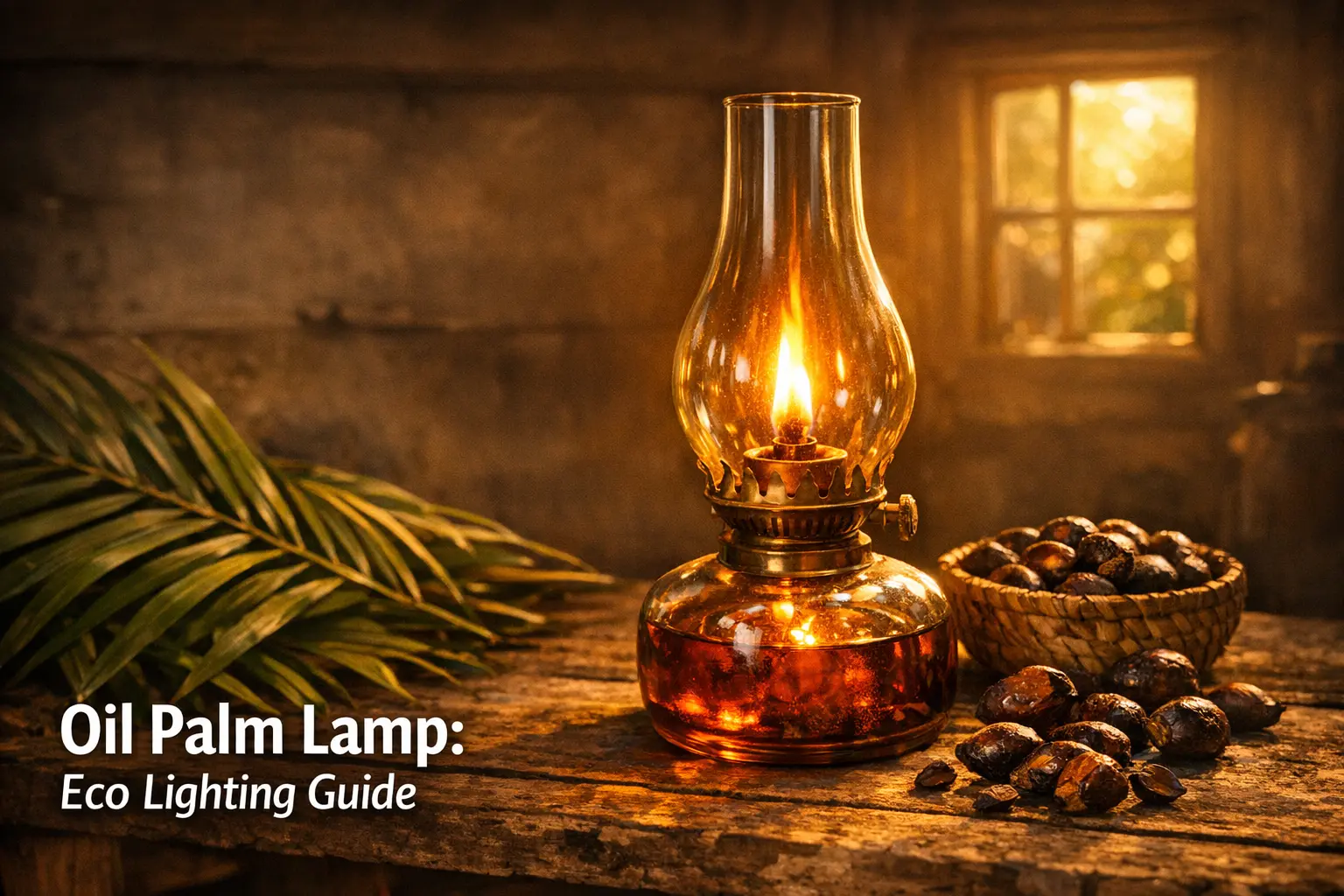
Picture a small household in rural Malaysia or Nigeria, far from the nearest power grid, where a simple flame fed by palm waste has replaced the smoky kerosene lamp that once gave children headaches every night they tried to study. That’s the oil palm lamp in action — not a concept, but a working solution that millions of farming communities have already embraced.
If you’ve been searching for whether this kind of lighting is real, practical, and worth the investment, you’re in the right place. This guide covers everything from the lamp’s origins to the safety factors no other article seems to mention.
What Exactly Is an Oil Palm Lamp?
An oil palm lamp is a lighting device that runs on fuel or energy derived from oil palm agricultural byproducts — primarily palm kernel shells, pressed fibers, empty fruit bunches (EFB), and residual crude palm oil. The palm tree (Elaeis guineensis) produces these in enormous quantities as a side effect of the global cooking-oil industry.
Rather than burning or burying this biomass waste, innovators and rural communities began redirecting it into low-cost lighting systems. The simplest models work like a traditional wick lamp — palm oil sits in a reservoir, a fiber wick draws it up, and the flame produces a warm, steady glow. More advanced versions gasify dried biomass to generate electricity that powers LED bulbs.
Why does this matter for US readers? The United States imports significant quantities of palm oil products and increasingly funds rural electrification abroad through USAID and development programs. Understanding how oil palm waste lighting works is directly relevant to anyone in sustainability, international development, or clean-energy investing.
A Brief History: From Waste to Light
Long before modern refineries, people in West Africa used crude palm oil as a lighting fuel centuries ago. Clay vessels and hollowed gourds served as early oil palm lamps. The practice was documented by Portuguese traders in the 15th century who noted the widespread use of palm oil for both cooking and illumination.
The industrial era largely replaced traditional palm-oil lamps with kerosene, but the idea never fully disappeared. When the 1970s oil crisis pushed kerosene prices up sharply, researchers in Malaysia and Nigeria revisited palm waste as a fuel source. By the 2000s, NGOs and university engineering programs had formalized the concept, creating replicable lamp models designed specifically for off-grid rural use.
Today, the oil palm lamp sits at the intersection of circular-economy thinking and community development — it addresses waste disposal and energy poverty in a single move.
Real Benefits Worth Knowing
Competitors cover the broad strokes, but here are the specifics that actually matter:
Cost reduction that sticks. A family in an oil palm farming region can potentially eliminate 60–80% of monthly kerosene costs once they switch to processed palm waste fuel, according to feasibility studies from the University of Malaysia Sabah. That’s not “saves money” — that’s a real budget shift.
Indoor air quality improvement. Kerosene combustion releases benzene and formaldehyde at concentrations the WHO classifies as harmful with daily exposure. A properly vented palm-oil lamp burning refined or filtered fuel produces significantly lower particulate emissions. It’s not zero-emission, but the difference is measurable.
Education and productivity gains. Field reports from NGO-supported projects in Ghana document a 23% increase in students’ self-reported nightly study time after households switched to palm waste lighting. Light access after sunset reshapes what’s possible in a day.
Waste reduction. Each ton of processed palm biomass diverted into fuel represents a ton that won’t decompose anaerobically and release methane — a greenhouse gas roughly 80 times more potent than CO₂ over a 20-year window.
How Oil Palm Lamp Systems Actually Work
There are three main configurations, and they differ significantly in complexity and output:
Simple wick systems use raw or filtered crude palm oil in a reservoir with a fiber wick. No processing equipment needed. Flame output is modest — enough for task lighting in a small room. Best for households with direct palm farm access.
Fuel briquette systems compress dried palm fibers and shells into dense bricks, which burn in a controlled combustion chamber attached to a lamp housing. More consistent heat and light output, but requires a briquette press and drying infrastructure.
Gasification + LED hybrid systems are the most advanced. Biomass is heated in a low-oxygen chamber (pyrolysis), producing syngas that fuels a small generator. The electricity powers standard LED bulbs. These deliver modern lighting quality and are increasingly supported by rural electrification NGOs in Indonesia and Cameroon.
The right choice depends entirely on what resources and technical capacity a community has.
Safety and Health: What Most Articles Skip
This is the gap neither competitor addresses adequately. Ventilation is non-negotiable. Any combustion-based oil palm lamp used indoors needs at least one open window or a dedicated vent. Without airflow, carbon monoxide builds up quietly — this is a genuine risk, not a theoretical one.
Fuel quality also matters more than most guides admit. Unfiltered crude palm oil contains water and plant debris that cause inconsistent burning and increased soot output. Running palm oil through a simple cloth filter before use reduces these issues significantly.
Lamp placement affects both safety and performance. Keep the flame at least 18 inches from curtains or thatch, and on a stable, non-combustible surface. A cracked clay or metal base is far safer than wood or plastic when heat builds up over hours of use.
If you’re evaluating an existing community project, watch how residents actually use the lamps — not just how they’re supposed to. Projects that skip user training on ventilation and fuel prep tend to fail not because the lamp design is bad, but because safe operation habits were never built in.
Is an Oil Palm Lamp Project Worth Supporting Today?
The short answer: yes, in the right context. The longer answer requires an honest look at limitations.
Oil palm lamps are not a replacement for grid electricity or high-quality solar systems where those are accessible. A $30–50 solar lantern with USB charging often outcompetes a palm-based lamp system on convenience and safety in communities that can afford it.
But in deep-rural agricultural regions where palm biomass is abundant, where kerosene costs are high, and where the capital for solar is out of reach, an oil palm lamp project is genuinely competitive. The key is matching the system type to community capacity — don’t introduce gasification systems where wick lamps would do the job and be easier to maintain.
Projects that succeed long-term share three traits: locally trained maintenance people, reliable biomass supply chains, and realistic expectations set from the start.
FAQ
What is an oil palm lamp?
An oil palm lamp is a lighting device powered by fuel or energy derived from oil palm agricultural waste — including shells, fibers, and residual palm oil. It converts byproducts from the palm oil industry into practical, low-cost lighting, making it particularly valuable in rural, off-grid regions where palm farming is common.
How is an oil palm lamp different from a regular kerosene lamp?
The fuel source is the key difference. A kerosene lamp relies on imported petroleum-derived fuel, while an oil palm lamp uses locally available agricultural waste. Palm-based lamps can reduce fuel costs significantly and, when properly vented, produce lower levels of harmful indoor emissions than kerosene.
Are oil palm lamps safe to use indoors?
They can be, but proper ventilation is essential. Combustion-based lamps produce carbon monoxide and particulates. Using a filtered fuel, maintaining airflow in the room, and keeping the lamp away from flammable materials are the three non-negotiable safety steps. Gasification-plus-LED hybrid systems carry lower indoor air risks.
Can oil palm lamp projects scale to larger communities?
Yes, but gradual scaling works better than rapid expansion. Projects that standardize fuel processing, train local repair technicians, and build community ownership tend to maintain performance over time. Jumping to district-level rollout before village-level systems are stable usually causes failure.
What’s the environmental impact of oil palm lamps compared to kerosene?
Switching from kerosene to palm waste lighting reduces dependence on fossil fuels and redirects agricultural byproducts that would otherwise decompose and release methane. The net environmental impact is positive when palm waste is genuinely surplus material — not when forests are cleared to grow more palms specifically for fuel.
Who funds oil palm lamp projects?
Funding typically comes from a mix of international development organizations (USAID, the UN’s SE4ALL initiative), regional NGOs, and national agricultural ministries in palm-growing countries. University research programs in Malaysia, Nigeria, and Indonesia have also played a significant role in refining lamp designs.
Can I build a basic oil palm lamp at home?
A simple wick-based oil palm lamp requires only a heat-safe container, filtered palm oil, and a natural-fiber wick (cotton works well). The design is straightforward and has been used for centuries. More advanced systems require fabrication skills and equipment, but basic working models are genuinely accessible at low cost.
What to Do Next
The oil palm lamp is a real, proven, and improving technology — not a trend or an untested idea. Whether you’re a sustainability researcher, a development program manager, or someone curious about renewable energy alternatives, the key takeaways are:
- Palm waste lighting works best as part of a broader rural energy strategy, not a standalone fix
- Safety training and ventilation practices matter as much as lamp design
- Hybrid systems combining biomass with LED technology represent the most promising path forward
- Community ownership and local supply chains determine long-term success more than technical specifications
If you’re evaluating an oil palm lamp project for support or implementation, start by visiting an existing working model rather than reviewing reports alone. What you see in real use will tell you more than any pilot study summary can.