Artists who don’t just create for the galleries but rather for the sake of transformation have a certain magnetic pull. In the case of Shani Levni, we are dealing here with a contemporary artist of the rarest kind whose works beyond mere aesthetics and provoke real debate on the topics of identity, belonging, and cultural memory.
When you go through one of her exhibitions, it is not like you are a spectator, but rather you are involved in a personal dialogue. Her paintings are not muted; they are directly talking to a deeper part of us, questioning our perception of both ourselves and the environment we live in.
The Artist Behind the Vision
Shani Levni’s artistic voice was significantly influenced by her upbringing in a culturally diverse environment that made her think of human beings as one big crowd and welcomed her to use storytelling as a medium of expression. She was an active participant in the whirlpool of every day family life and was also a witness to history, thus her finding an intrigue in how personal stories are told in connection with the memory of the society as a whole.
Bezalel Academy of Arts and Design in Jerusalem was the place where she learnt the techniques that supported her creativity, but the Berlin’s MFA in Art Theory that she pursued later on was the thing that actually sharpened her mind. There she pursued the same lines of thought that would later on form the basis of her artistic production: how trauma, memory and culture could be expressed through layered compositions.
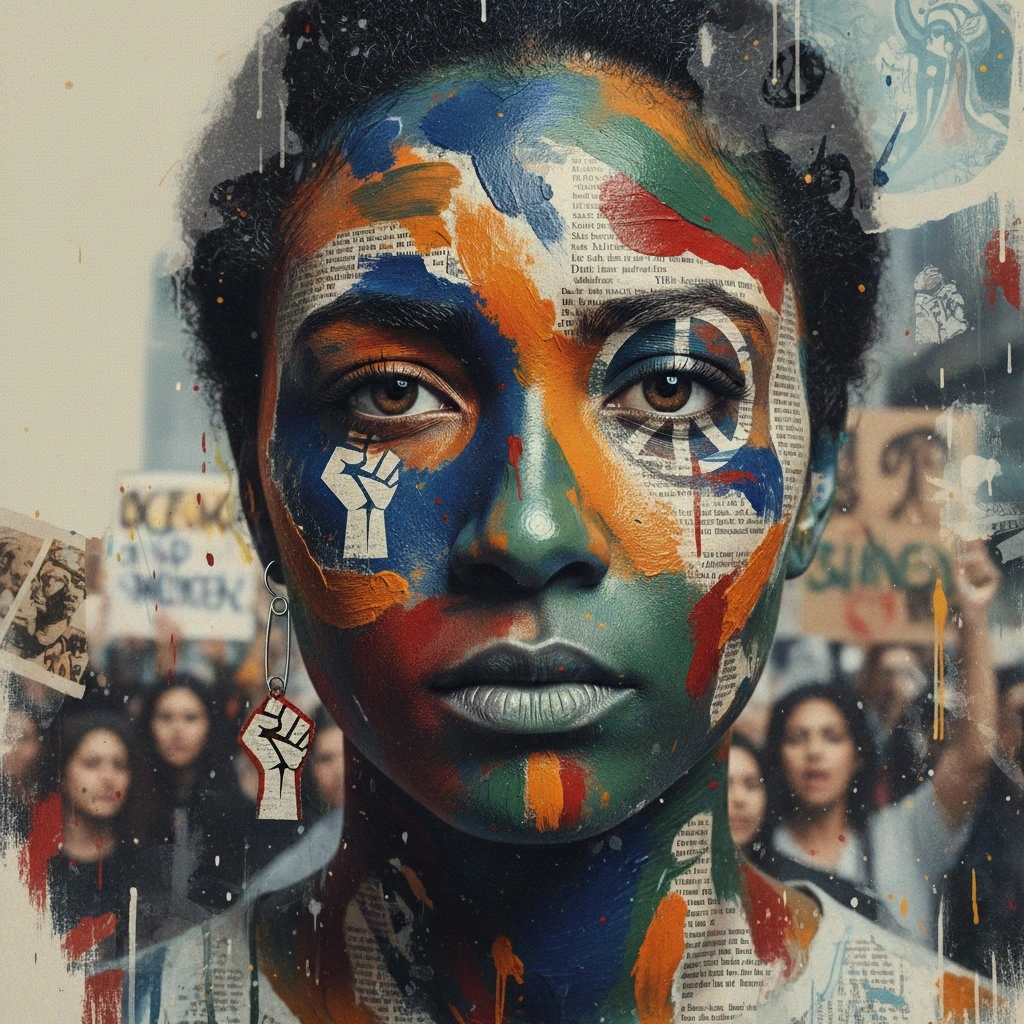
Unlike many artists who stick to a certain style for the whole of their life, Levni is always on the move forward. She constantly creates, she constantly changes her style, she constantly looks for new media in her works, the way giving birth to most original ones and perhaps the most challenging ones to come into contact with for the audience to perceive—the blending of layers made of fabric, paper and paint, and the creation of textures thus mainly suggestive of an archaeological phenomenon where each viewing of a work reveals a new layer in the past underneath.
Breaking Down Her Artistic Language
What makes Shani Levni’s work instantly recognizable The way she balances intensity with restraint is the answer. Her paintings usually consist of very thick material showing the fact that history is never one or just that. Olive branches are mixed together with Hebrew letters. Paint layers allow us to see the symbols underneath the top layer.
“Whispers of the Olive Tree,” her highly appreciated work, is the center of the pottery at the museum and the one that has earned Shani Levni the most praise for expressing great feelings and at the same time using political metaphors barely seen. The critics called it a summon of the ancestors’ voices that keep on echoing during the march of time.
At the Jerusalem Biennale, she continued to break through the artistic barriers with “Letters Never Sent”—an installation of over one hundred handwritten scrolls hanging from the ceiling, each containing a note collected from people who had been displaced. The public did not just look on but rather walked through the stories, thus being physically involved with the issues of migration and silence.
“Between Earth and Sky,” her solo exhibition at the Rosenfeld Gallery, was an investigation into the connection between the material and the spiritual domains of belonging. The show revealed her power to transform the most abstract concepts into something very personal and accessible to the audience.
Art as a Tool for Social Change
Levni is different from many contemporary artists here: she not only does not separate the community engagement from her creative practice but also fuses them together. The Root Collective, a nonprofit, was founded by her, which supports refugees and immigrant youth through art workshops in Europe and the Middle East.
These initiatives are not merely symbolic or good-for-the-soul ones. The workshops are a place where the participants can change their traumas into visual form, thus making it possible for their works to be created in the form of public murals and exhibitions that celebrate the resilience of the community. Levni’s teaching is centered around storytelling, empathy, and collaboration—making the whole process of creation into a healer.
Through her community projects and advocacy initiatives, she is not only trying to build the power of the marginalized but also to use art as a means for social healing. She joins the exhibitions with the workshops and thereby creates a space where the dialogue and reflection take place always and naturally.
Moreover, she has spread her message to wider platforms, giving talks at TEDx Jaffa, UNESCO Culture & Healing Panels, and the Berlin Biennale Symposium. She has made a commitment to the use of art as a social tool that goes far beyond the canvas.
The Themes That Define Her Work
If you visit a Levni exhibition, you would not fail to notice the recurring themes that are at the same time, universal and very personal:
Identity and Belonging: She digs into the very essence of belonging—geographically, culturally, and spiritually. The artist often depicts the cracking points between being rooted and being displaced, tradition and modernity.
Memory as Material: From her thesis work, she gives the audience the possibility to see and feel the layers of trauma and cultural memories of the past through collective memory and cultural trauma. History is presented as almost a physical presence.
Spiritual Symbolism: During her exhibition “A Parallel Universe” at Sputnik Gallery, she presented paintings full of symbolic and spiritual imagery which included even the “72 names of God.” The exhibition was interactive that it invited the audience to participate through thought-provoking activities such as placing symbolic cards.
Transformation and Resilience: The artist’s work no matter whether it is the personal or societal healing always goes back to the idea of transformation—how people and communities change, endure, and finally reap the benefits of their patience.
Why Her Approach Resonates Now
The year is one of splintered identities, as individuals more and more often find themselves snared between cultural spheres, spatial points, and ideological systems. Levni is of the opinion that art has the capacity to connect people, thus, to create understanding in a society that is becoming more and more segregated.
Her creation is, to say the least, not a source of easy solutions or comfy conclusions. Quite to the contrary, it is in the very midst of the ongoing complexity. It takes the hurt into account but still praises the strength that comes with suffering. It concedes the past and offers the future at the same time.
This multi-faceted way seems to be very appropriate and appealing to the oversimplified narratives we all are tired of. In other words, through the medium of her work Levni invites the public to experience and contemplate the very complex and difficult reality of being human in this world.
The Technical Mastery Behind the Emotion
The emotional effect of Levni’s work is what first attracts the attention, but one should not ignore her technical skill. She shows excellent mastery of color, texture, and composition, knowing perfectly when to complicate and when to simplify the work.
Through her special way of painting, she uses bright colors and adds a lot of tiny details to make viewers feel more connected to the art. The artist is making every stroke of the brush to tell a part of the story without confusing the main idea.
The artist’s mixed-media technique requires a deep understanding of the interactions of various materials. The process of layering fabric, paper, and paint is very demanding in terms of both time and skill. The artist’s textural effects are like natural ones but at the same time they are deliberate; they can be viewed as accidental but also as controlled ones.
A Growing Influence on Contemporary Art
Her reputation was growing steadily as she was going through galleries and exhibitions, becoming not only a talented artist but also an artist who could connect personal struggles and societal issues through art.
The younger artists especially look up to her for the way she has constructed a career that does not sacrifice commercial success for social impact. She has shown that it is possible to have both: Making art that has meaning and getting it to be seen by larger audiences.
Her workshops and mentorship programs, that are already described as “the artist’s guide to uncharted territories”, help bloom the voices of artists that are still weak and make them try even the most daring and most vulnerable. She invites them to do so, and tells them to not limit themselves to self-expressive arts but to also use their platforms as a means of communication.
Looking Forward
Shani Levni’s inevitable ever-expanding horizons are not only the endless possibilities to come but she will also be going through the new mediums, cross-cultural collaborations, and digital platforms aspect to enlarge her audience worldwide.
The digital art forms are what she is beginning to experiment with, and that means investigating how after all technology can be a help rather than a manual replacement of art techniques. Early trials indicate that she will impose the same emotional involvement and precision in digital production as in her physical artworks.
Newly developed collaborative relationships with different cultures are becoming more and more appealing to her—she sees such collaborations as artists of different origins coming together to deliver projects that not only permeate the boundaries but also create understanding. These alliances resonate closely with her fundamental conviction of art being a unifying force rather than a dividing one.
The art of Shani Levni is a constant reminder that it can be simultaneously beautiful, thematic, healing, and transforming. Her artworks do not exist away from the influence of isolation—their living, breathing, and evolving presence is mainly through interaction with communities from which she gets engaged. Be it through her painstakingly created paintings, captivating installations, or through her sharing of knowledge in the form of workshops, she keeps on proving that the magical combination of creativity and true compassion is the one that makes the change rings far beyond the gallery walls.