
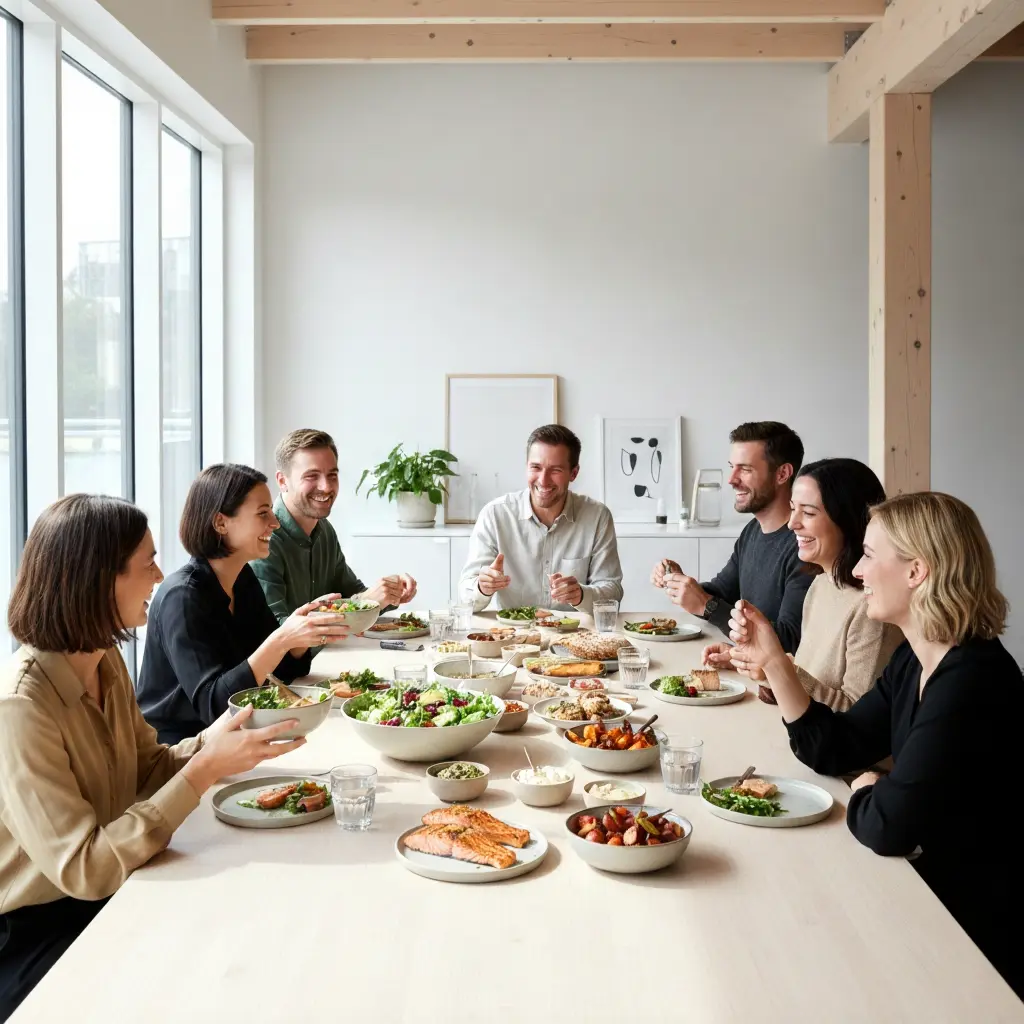
For many people, the term workplace culture immediately brings to mind free snacks or casual Friday. However, Sweden has a custom that is based on something much more profound than benefits or rules. The custom is called bjudlunch, and it is slowly but surely changing the way professionals in different parts of the world think about connection, trust, and relationships.
In case you are curious, here is the explanation for the simple lunch becoming a cultural phenomenon: this Swedish practice is indeed gaining attention not only in Scandinavia but also across the globe!
What Does Bjudlunch Actually Mean?
The term bjudlunch is derived from the combination of two Swedish words: bjuda which means to invite or treat and lunch which is self-explanatory. If you bring them together, the resulting idea is to invite someone to lunch and pay for it as a sign of sincere goodwill.
However, the twist here is that the whole idea of bjudlunch revolves around the fact that it does not concern impressing people or creating obligations. It is neither a power play nor a networking tactic dressed up as kindness. Rather, it embodies a very important aspect of the Swedish way of life: the conviction that sharing meals is a form of connecting people that is not only genuine but also without any conditions attached.
A bjudlunch is thus the direct opposite of a business lunch that is purely in the nature of transaction. By offering a bjudlunch, one is basically conveying the message, “Our relationship is so important that I want to take a break, have lunch together with you and give you all my attention.” This simple gesture has the power of creating a bond that is much stronger than that of a scheduled meeting and an email chain.
The Cultural Roots That Make Bjudlunch Special
The social values of Sweden are behind every aspect of bjudlunch. At the top of the Swedish culture, in its very soul, is equality, which the bjudlunch practice will always avoid creating any kind of social hierarchy or debt between people. The treatment of someone’s lunch will not impose any obligation or guilt upon the receiver to reciprocate or do other things soon.
This also relates to another Swedish characteristic: lagom, which can be loosely translated as “neither too much nor too little.” Bjudlunches usually take place in rather plain places, such as a corner café, cafeteria in a workplace, or a casual bistro. The conversation and connecting with others are what the people around the table are interested in; not the expensive menus or the fancy places.
The sharing of food in the Scandinavian communities was of great importance, especially during the long needy winters and difficult times, as it maintained the connection among the people. With the modernizing of Sweden’s society and people working in more organized settings, a bjudlunch would still serve as a means that is flexible to build up professional relationships, to welcome newcomers, and to express gratitude without the use of formality.
Why Bjudlunch Works in Modern Workplaces
Modifying a work plan to include remote work, taking hybrid schedules, and using digital means to communicate all contributed to the weakening of authentic connection. A rapid Slack message or a video call is used up in its purpose but there is a loss in effectiveness when the entire interaction takes place through screens.
Here is where bjudlunch comes in as an easy answer. Companies that have accepted this practice report significant advantages that are not limited just to moments of good feeling. Trust is being built up among teams through regular lunches together and sharing. Workplace friendships between project teammates, who usually only contact each other for updates, suddenly share and get to know each other’s points of view, interests, and work styles.
The new hires notice a change right away. They don’t have to go through their first weeks alone but rather just a warm bjudlunch with co-workers that creates an instant feeling of belonging. That early bonding sometimes decides if a person is going to succeed in his role or not and if he is going to be isolated from the team from day one.
Such is the reasoning for this phenomenon in psychology. When we share food without obligation, the brains of the individuals involved signal them that it is safe to be open. The talk is then easier and more people are willing to give ideas that they would have kept to themselves during formal meetings. A lunch break that lasts 45 minutes can do what hours of email communication could never achieve.
How Bjudlunch Plays Out in Real Situations
Let’s examine the operation of bjudlunch under different scenarios. In an office environment, a boss might take a colleague to lunch as a personal thank-you who has just finished a difficult project. It is not a formal recognition ceremony, nor is it a public announcement—just the sharing of appreciation in sandwiches and coffee.
The business development departments are using bjudlunch for building relationships with clients. Rather than planning another meeting in a conference room, they offer a laid-back lunch at a local restaurant. The change of place works wonders for the atmosphere. Instead of account numbers, clients become human beings, and this connection facilitates future collaborations.
Mentorship relationships are highly advantageous to the periodic bjudlunches. A senior colleague’s taking a junior team member to lunch creates room for honest discussions covering career progress, workplace difficulties, and professional development that might seem awkward in the office.
Internal networking still improves through bjudlunch schemes. The participation of employees getting randomly assigned for monthly lunches goes on as an opt-in initiative in certain organizations. Such informal meetings weaken ties between departments and lead to unexpected partnerships.
The Unspoken Etiquette That Matters
Bjudlunch etiquette understanding means no awkward moments and a true feeling of the tradition instead. The thing that matters most is the rule of the game? Clarity is the king. If you want to invite someone and treat them, do it the clear way. There would be no more confusion if you just say, “I’d love to treat you to lunch next week.”
Thinkingfulness is the defining characteristic of the location choice. A place that is comfortable and allows good conversation is the one to choose instead of expensive restaurants that won’t tell you as much as impress. The aim here is to the environment where people can let their guards down and be comfortable talking.
The right time also plays an important role. Most bjudlunches take up to 45-90 minutes. To stick to that schedule is to show respect for the other person’s time and to be more likely to receive their acceptance of future invitations.
An often neglected point is that when you invite someone out for lunch, you should always ask for their dietary preferences or restrictions. This question that seems to be so small actually reflects a very caring attitude and also prevents a very inconvenient situation when the food is served.
Adapting Bjudlunch for Remote Teams
The transition to remote work has not put an end to bjudlunch; it just has gone through a change. Proactive companies are the ones that conduct the bjudlunch virtually, giving meal delivery credit to employees for online lunch gatherings. It may not be identical to sharing a physical space but the purpose is still the same: to make sure there is a time for connection beyond the work tasks.
Some teams designate quarterly bjudlunches in person on the occasions that team members come to the main office, thus making those reunions very significant highlights instead of mere routine. The infrequency does indeed help to boost the impact by giving people something to anticipate and creating stronger memories.
Key Takeaways for Implementing Bjudlunch
If you start your own bjudlunch practice, it is not necessary to make any policy changes company-wide. Just at the beginning make some small actions that show the party’s spirit. Have lunch with a co-worker who has helped you out lately and let him/her know that it is on you. Observe how that one act alters your professional relationship.
If you are a team leader, you might consider making bjudlunch part of the onboarding process. New employees who have lunch with their boss and a few co-workers in the first week say they feel more connected and supported right from the beginning.
Keep the custom simple and true. The moment bjudlunch no longer is another checkbox on a corporate program, it loses its power. Make it remain natural, personal, and based on real gratitude instead of duty.
Do not forget that bjudlunch prevails because it favors people over productivity, connection over efficiency, and humanity over hierarchy. Those principles will apply no matter if you are in Stockholm or San Francisco managing five or fifty people.
Conclusion
The charm of bjudlunch is its unpretentiousness. While the world is in a frenzy over optimization and scaling, bringing this Swedish practice into the conversation is tantamount to saying that the strongest instruments for relationship-building still need the human touch. They cannot be automated or outsourced; they need face-to-face interaction, focus, and the quality of time given to another with the hope of no immediate return.
If you are interested in making your team culture more alive, professional relationships deeper or simply more honest connections at work, bjudlunch is the way to go. It’s not hard, doesn’t need any special resources and it works because it connects with a very human aspect: the need for connection, sharing and being appreciated by the people around us.
The next time you feel like giving thanks, making a new colleague feel at home, or turning a work acquaintance into a true friend, don’t opt for a met meeting. Rather, extend a lunch invitation. You may be astonished at what a meal shared can achieve.